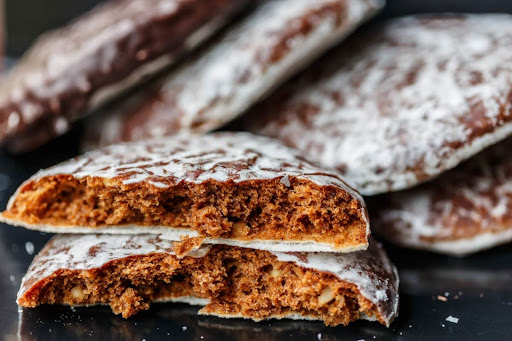
Traditional Lebkuchen
History & Background
The spiced honey-cake known today as Lebkuchen has a lineage stretching back much farther than Christmas markets and gingerbread houses. Monastic records suggest that honey-sweetened cakes—often made with local nuts, flour scraps, and the honey gleaned from monastery apiaries—were baked as early as the 13th century by the friars of Franconia.
What makes Lebkuchen distinct is how it arose at the nexus of three medieval forces: the spice trade, monastic-hive industry, and religious festival culture. As the salt and spice routes passed through cities like Nuremberg (Nürnberg), the availability of cinnamon, cloves, ginger, and more allowed bakers to transform the humble honey-cake into a luxuriously spiced treat.
Even more intriguingly, many early Lebkuchen were baked on thin communion-wafer-like sheets called “Oblaten” to prevent sticking—a technique first used by monastery bakers and later adopted by guilds.
By the 14th and 15th centuries, dedicated guilds—the “Lebzelter” in cities like Ulm (1296) and Nuremberg (1395)—were producing Lebkuchen in large quantities for fairs, festivals, and long-winter storage.
This rich historical tapestry—of honey from the forests, spices from distant lands, and the faith-shaped rhythm of European winter festivals—makes Lebkuchen more than just a cookie. It’s a taste of tradition, trade, and time.
In contrast to the average Lebkuchen, the Elisenlebkuchen, for which Nürnberg is famous, use zero flour and only almond or nut meal(s).
Ingredients
Makes about 24 medium cookies (depending on size).
Dry & Spice ingredients
- 2 cups all-purpose flour (≈ 240 g)
- ½ teaspoon baking soda (≈ 2 g)
- 1½ teaspoons ground cinnamon (≈ 3.5 g)
- 1 teaspoon ground ginger (≈ 2.5 g)
- ½ teaspoon ground cloves (≈ 1.2 g)
- ½ teaspoon ground nutmeg (≈ 1.2 g)
- ¼ teaspoon ground cardamom (≈ 0.6 g)
- ¼ teaspoon salt (≈ 1.5 g)
- 1½ cups ground almonds or almond meal (≈ 150 g)
- Optional: ¼ cup finely chopped candied orange peel (≈ 35 g)
- Optional: ¼ cup finely chopped candied lemon peel (≈ 35 g)
Wet & Sweetening Ingredients
- ½ cup honey (≈ 170 g)
- ½ cup brown sugar, packed (≈ 110 g)
- ¼ cup unsalted butter, softened (≈ 57 g)
- 2 large eggs
- 1 teaspoon vanilla extract (≈ 5 ml)
Glaze / Finish
- 1 cup powdered sugar (≈ 120 g)
- 1–2 tablespoons milk (≈ 15-30 ml)
- Optional: 1 tablespoon dark chocolate, melted (for dipping)
Step-by-Step Directions
Pre-heat & prep
1.Preheat your oven to 325 °F (≈ 165 °C). Line two baking sheets with parchment paper, or if you like something more traditional, place thin edible wafer-sheets (“Oblaten”) under each cookie mound to mimic historic method.
Mix dry ingredients
2) In a large mixing bowl, whisk together the flour, baking soda, cinnamon, ginger, cloves, nutmeg, cardamom, salt and ground almonds. If using the candied peel, keep that separate for now.
Cream wet ingredients
3) In another bowl, cream the softened butter, brown sugar and honey until smooth and slightly fluffy. Add the eggs one at a time, beating to combine, then stir in the vanilla extract. Fold in the candied peel if using.
Combine dough
4)Add the wet ingredient mixture into the bowl of dry ingredients. Stir gently until a soft, slightly sticky dough forms. If the dough feels too loose to handle, chill it for 20–30 minutes to help firm it up (makes shaping easier).
Shape & bake
5)Using a tablespoon or cookie scoop, portion the dough into about 24 mounds (depending on how large you make them). Place them on the prepared baking sheets, leaving about 2 inches (≈ 5 cm) between each cookie. Gently flatten each mound to about ½-inch (≈ 1.3 cm) thick.
Bake in the pre-heated oven for approximately 12–15 minutes, until the edges are just set and the centers still appear slightly soft. Do not overbake—the cookies should remain moist inside.
Cool & glaze
6)Remove the baking sheets from the oven and allow the cookies to cool on the sheets for about 5 minutes. Then transfer them onto a cooling rack.
Meanwhile, whisk the powdered sugar with milk until you reach a smooth glaze (thick but pourable). While the cookies are still warm, drizzle or brush the glaze over them. If you like, dip half of each cookie in melted dark chocolate for an elegant finish.
Mature for best flavor
7)For full flavour and optimal texture, once glazed and cooled, store the cookies in an airtight container for 24-48 hours before serving. This “resting” period allows the spice-honey-nut flavour to deepen and the texture to settle.
Serving Suggestions
- Present the Lebkuchen alongside a steaming mug of mulled wine (Glühwein) or hot spiced tea—perfect for evoking a snow-lit market square.
- On a wooden board or festive platter, accompany them with roasted chestnuts, marzipan pralines, and small ornaments to mirror the Christkindlmarkt atmosphere.
- For gifting: wrap cookies individually in clear cellophane, tie with red ribbon and add a small label—e.g., “Vienna-style Lebkuchen – sharing holiday joy.”
Bon Appétit!